The Expressive Range of Maheria Script: From Handwritten Notes to Brand Identity
Across the landscape of modern typography and personal handwriting styles, few approaches manage to balance legibility with expressive character as effectively as Maheria Script. This distinctive style has quietly gained traction among designers, educators, business owners, and creative hobbyists who seek a script that feels both personal and professional. Rather than fitting neatly into a single category of calligraphy or digital font, Maheria Script occupies a space where intentional strokes meet everyday readability. Understanding what makes this script style useful requires looking beyond aesthetic appeal and into how it functions across real-world contexts.
Where Maheria Script Appears in Everyday Workflows
One of the most telling indicators of a script style's relevance is the range of settings in which it appears naturally. Maheria Script shows up in branding materials where companies want to convey approachability without sacrificing professionalism. A local coffee shop might use it on menu boards and packaging labels to create a warm, handcrafted feel. A freelance graphic designer may incorporate it into logos for clients in the wellness or creative sectors, where the script's流畅 curves suggest motion and authenticity. The style works equally well in digital invitations, social media graphics, and short-form print pieces such as quote cards or thank-you notes.
In educational environments, Maheria Script appears in classroom displays, worksheets, and instructional materials aimed at younger learners. Teachers who introduce handwriting practice often look for models that are clear yet engaging, and this script provides a template that students can observe and eventually imitate. The letterforms carry enough individual personality to spark interest in the act of writing itself, which is a subtle but significant advantage over more mechanical or strictly uniform styles.
Business owners who manage their own customer communications, signage, or product labeling frequently turn to Maheria Script because it requires no advanced calligraphy tools to execute well. A simple gel pen or marker produces consistent results, making the style accessible to anyone who wants to add a handmade quality to their work without investing in specialized equipment or extensive training. This practicality has led to its use in small-batch product packaging, farmers market signage, and boutique retail tags where budget constraints meet the desire for visual distinction.
The Built-In Advantages of the Script's Construction
The structural choices embedded in Maheria Script contribute directly to its usefulness. One notable characteristic is the consistent slant and spacing between letters, which prevents the script from appearing hurried or messy even when written at moderate speed. This consistency makes it easier for readers to decode words quickly, a factor that matters in contexts like menu boards or directional signs where information needs to be absorbed at a glance. The letterforms themselves tend to avoid excessive loops or ornamental flourishes that might compromise legibility at smaller sizes or when viewed from a distance.
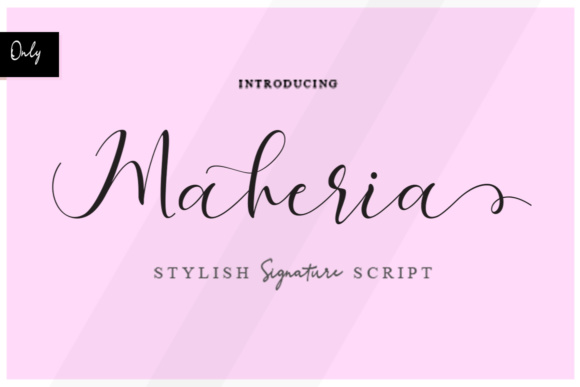
Another advantage lies in the distinctive shape of key letters such as the lowercase 'a', 'e', and 'g'. These characters retain enough of their traditional forms to remain immediately recognizable, while subtle variations in stroke weight add visual interest. Designers working with Maheria Script in digital formats appreciate that the character set includes both standard ligatures and contextual alternates, allowing for natural variation in repeated words or phrases. This flexibility is especially valuable in branding and packaging where the same script must appear across multiple touchpoints without looking repetitive or robotic.
For educators and handwriting researchers, the script's stroke sequence and flow patterns offer a useful model for teaching connected writing. The transitions between letters are smooth without requiring exaggerated pen lifts, which reduces hand fatigue during longer writing sessions. Children and adults who practice this script often report that it feels more intuitive than other cursive styles because the movement patterns align well with natural hand motion. This ergonomic consideration is rarely discussed in typography conversations, but it directly affects whether a script style gets adopted for regular use or remains an occasional decorative choice.
Who Benefits Most from Adopting Maheria Script
The audience for Maheria Script is broader than one might assume. Creative professionals such as illustrators, surface pattern designers, and lettering artists use it as a foundational style that can be modified for specific projects. Because the base script is clean and consistent, it accepts personal variations well—adding a bounce to the baseline, exaggerating descenders, or introducing slight weight shifts all produce coherent results without breaking the underlying structure. This makes it a reliable starting point for experimentation.
Small business owners and solopreneurs who handle their own marketing materials find that Maheria Script provides a cohesive visual element across platforms. A handwritten menu, a social media post, a product label, and a website header can all feature the same script treatment, creating brand recognition without requiring a dedicated design team. The script works in both digital and analog formats, which matters for businesses that operate across online and physical spaces. A bakery might use it on Instagram stories and on the chalkboard inside the shop, maintaining consistency without extra effort.
Educators and workshop facilitators who teach handwriting, journaling, or creative lettering appreciate that Maheria Script offers a clear model for demonstration while leaving room for individual expression. It is structured enough to teach in a group setting, where learners need shared reference points, but fluid enough that students do not feel constrained by rigid rules. This balance is difficult to achieve in script styles that prioritize either strict uniformity or extreme personal flair.
Researchers and hobbyists interested in the evolution of handwriting observe that Maheria Script reflects contemporary preferences for scripts that are neither overly formal nor completely casual. It occupies a middle ground that may signal a broader cultural shift toward handwriting that values clarity without sacrificing warmth. In an era where much written communication happens through typed text, the deliberate choice to use a script like this carries meaning—it signals care, intention, and a human presence behind the words.
Practical Considerations for Implementation
Adopting Maheria Script in a project or practice involves several factors that affect the final result. Tool choice matters: fine-tip markers, fountain pens with moderate flex nibs, and digital styluses with pressure sensitivity all produce slightly different interpretations of the script. For print applications, a consistent ink flow and smooth paper surface help maintain the clean lines that define the style. For digital use, selecting a well-crafted font version of Maheria Script that includes proper kerning, ligatures, and alternate characters ensures that the output reads naturally rather than looking like disconnected letterforms placed side by side.
Scale and medium influence how the script is perceived. At large sizes, such as on posters or wall murals, the subtle weight variations become more pronounced and add texture to the design. At small sizes, such as on business cards or product labels, the simplicity of the letter shapes ensures that the text remains readable without zooming in. Designers should test the chosen weight and spacing at the intended output size before finalizing any project, as scripts that look balanced on screen may appear too dense or too airy when printed at actual dimensions.
For individuals learning to write Maheria Script by hand, consistent practice with basic strokes yields faster improvement than attempting full words or sentences from the start. The undercurve and overcurve movements that connect letters are the foundation of the script's flow. Warm-up exercises focusing on these transitions, combined with attention to slant consistency, build muscle memory that supports natural writing speed. Many practitioners find that dedicating ten minutes a day to stroke practice for two weeks produces noticeable improvement in letter formation and overall rhythm.
Observations on Script Styles in a Typed World
The growing interest in Maheria Script and similar handwriting styles reflects a broader cultural shift. As digital communication becomes more automated and impersonal, the deliberate act of writing—or designing with a script that mimics handwriting—carries emotional weight. A handwritten note in Maheria Script communicates effort and personal attention that a typed message cannot replicate. Businesses that incorporate script into their branding tap into this perception, signaling that they value human connection over transactional efficiency.
In educational settings, the reintroduction of connected handwriting practice through styles like Maheria Script has shown benefits beyond penmanship. Research in cognitive development suggests that the act of forming letters by hand engages neural pathways related to memory, comprehension, and creative thinking in ways that typing does not. Scripts that are pleasant to write and easy to read encourage more frequent practice, which amplifies these cognitive benefits. The choice of script style, then, becomes not merely an aesthetic decision but a factor in how learners engage with written language itself.
From a design perspective, Maheria Script exemplifies a trend toward typographic neutrality infused with personality. Unlike ornate calligraphy scripts that demand attention and can overwhelm other design elements, this script integrates smoothly into layouts where the message itself should remain central. It supports the content rather than competing with it. This quality makes it a versatile tool for designers who need a script solution that works across multiple projects without feeling repetitive or predictable.
The longevity of any script style depends on its adaptability to new contexts. Maheria Script has demonstrated resilience across analog and digital platforms, suggesting that its underlying principles—clear letterforms, consistent rhythm, practical ergonomics—are robust enough to remain relevant as technology and aesthetic preferences evolve. Whether used in a handwritten journal, a restaurant menu, a classroom worksheet, or a brand identity system, it offers a balance that few script styles achieve: enough character to be memorable, enough restraint to be useful.